
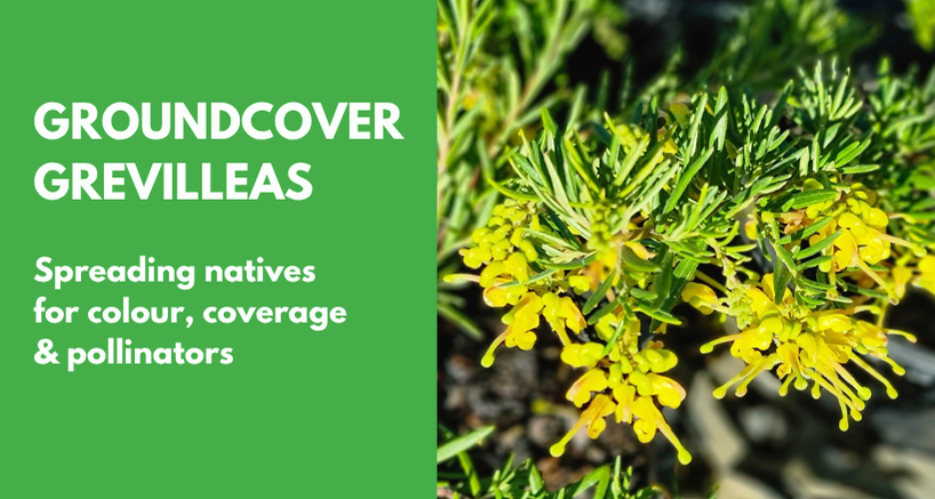
Groundcover grevilleas: low-growing natives for colour, coverage and pollinators
Looking for an Australian native groundcover that can bring more than just green foliage to a landscape?
Groundcover Grevilleas combine spreading growth with colourful flowers, interesting foliage and valuable habitat. Depending on the variety, they can be used across embankments, retaining walls, rockeries, borders, mass plantings and larger areas where you want to reduce exposed soil without adding too much height.
Most prefer a sunny position and well-drained soil, and many become drought tolerant once established. Their nectar-rich flowers can also attract birds and insects, giving them another role within habitat-friendly planting.
And there is much more variety than you might expect. Groundcover and spreading Grevilleas range from bright red and gold flowers to bronze and burgundy new foliage, with some hugging the ground and others forming broader, low-spreading shrubs.
Why use Groundcover Grevilleas?
A good groundcover does much more than fill an empty space.
As spreading plants establish, they begin to cover exposed soil and connect the different layers of a planting. They can soften hard landscape edges, spill over walls, spread through difficult areas and add another layer beneath taller shrubs and trees.
Groundcover Grevilleas can be particularly useful for:
slopes and embankments
retaining walls
rockeries
borders and foreground planting
mass native planting
habitat and pollinator-friendly gardens
low-maintenance landscapes
adding colour without adding significant height
covering open ground between larger shrubs and trees
Their nectar-rich flowers are another advantage, with many Grevilleas attracting nectar-feeding birds and insects.
Can Groundcover Grevilleas help reduce weeds?
Yes. Dense groundcover Grevilleas can help reduce weed pressure by covering exposed soil and occupying space where weeds might otherwise establish.
Bare soil provides an opportunity for weeds to take hold. As groundcovers spread, more of the soil surface becomes shaded and occupied by foliage and roots.
Groundcover planting should not be considered an instant weed-free solution, particularly while plants are establishing, but it can form a useful part of a broader weed-management approach.
Grevillea juniperina Gold Cluster is a good example. Its dense, low-growing habit can help compete with weeds while creating a spreading layer of foliage and flowers.
Groundcovers and mulch can also work together while new plantings establish. Over time, as plants spread and gaps begin to close, there may be less exposed soil needing to be covered.
Groundcover Grevilleas to look out for
Red and pink Groundcover Grevilleas
Low-growing doesn’t have to mean subtle. These red and pink Grevilleas bring plenty of colour into the landscape.
From bright pops of red to softer pink tones, they add strong seasonal flower impact while spreading through borders, slopes and open areas.
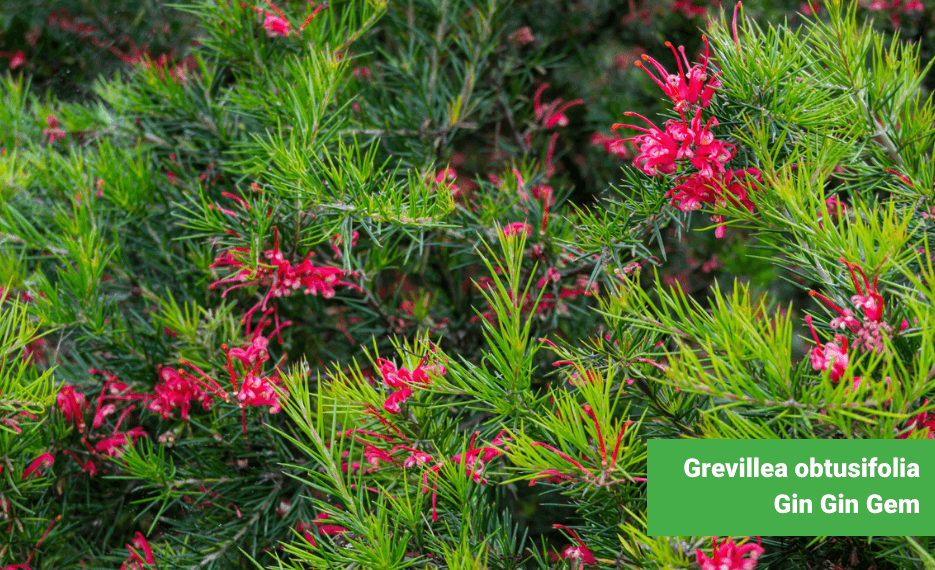
Grevillea obtusifolia Gin Gin Gem
Obtuse-leaved Grevillea
Grevillea Gin Gin Gem forms a dense carpet of bright green foliage with small red spider-like flowers over a long flowering period.
Growing to approximately 30cm high and around 2m wide, it is a useful choice for rockeries, embankments and areas where broad, low coverage is needed. Its nectar-rich flowers also attract visiting birds.
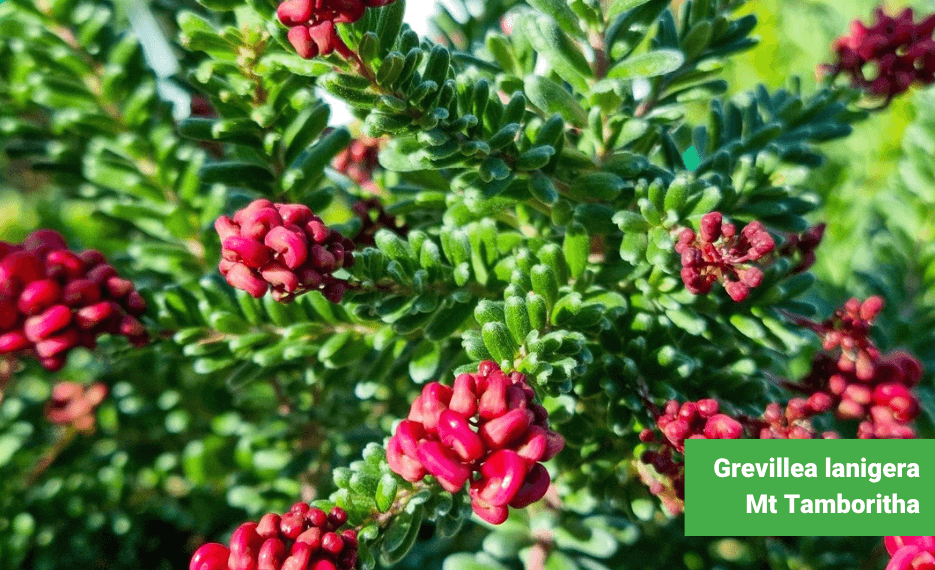
Grevillea lanigera Mt Tamboritha
Woolly Grevillea
One of our most popular groundcover Grevilleas, Grevillea lanigera Mt Tamboritha has small, oval-shaped leaves covered in fine hairs, giving the foliage its distinctive slightly woolly appearance.
Pinkish-red and cream flowers appear from late winter into spring. Its compact spreading habit works particularly well in rockeries, borders and low native planting.
Growing to approximately 40cm high and 1–2m wide, Mt Tamboritha is also tolerant of dry periods once established. It prefers cooler conditions and is less suited to high humidity.
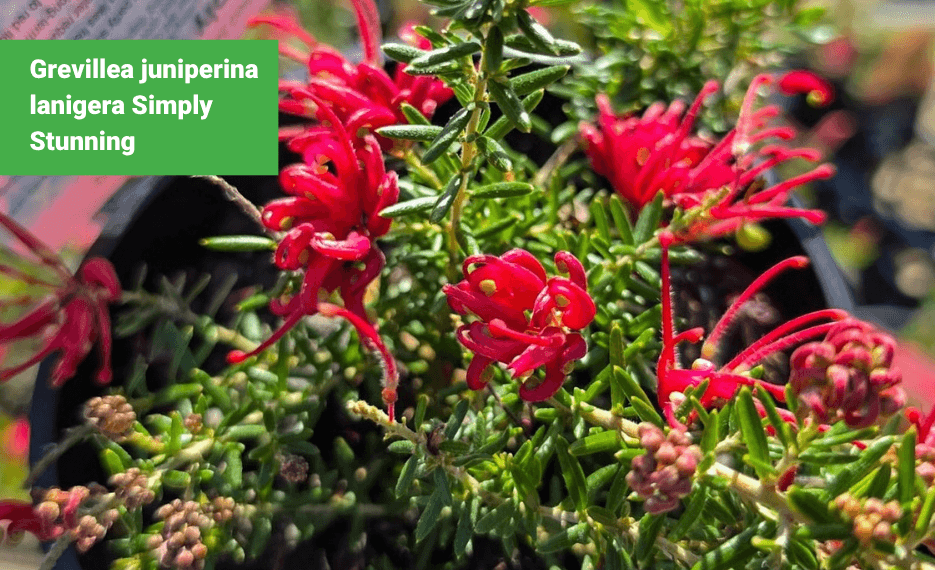
Grevillea juniperina lanigera Simply Stunning
Juniper Leaf Grevillea or Woolly Grevillea
Grevillea Simply Stunning combines fine evergreen foliage with masses of pink to red flowers.
Its low, spreading form reaches approximately 60cm high and 2m wide, making it useful through borders, embankments and larger native plantings where coverage and flower colour are both important.
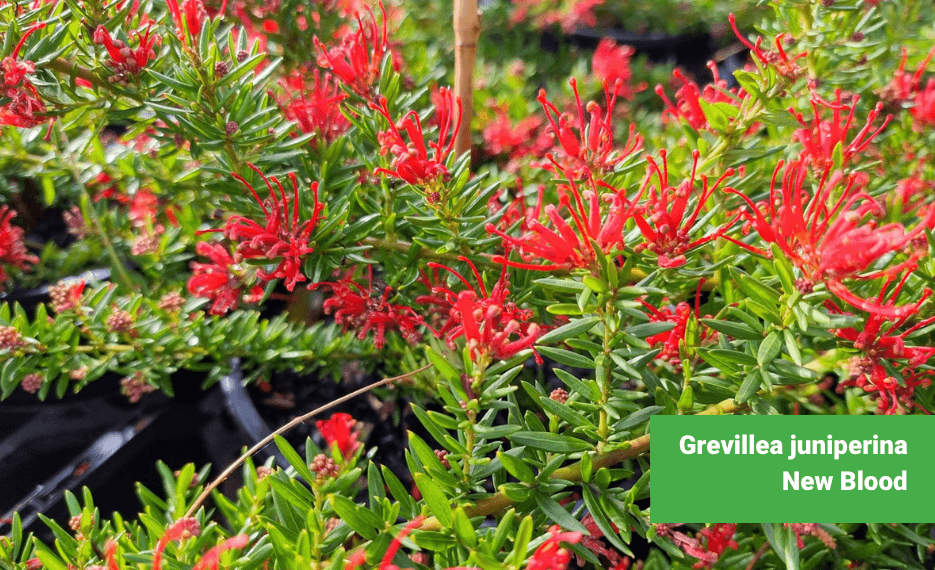
Grevillea juniperina New Blood
Juniper Leaf Grevillea
If strong colour close to ground level is the goal, Grevillea New Blood is worth considering.
It stays particularly low at around 25cm high while spreading to approximately 1.5m. Fine needle-like foliage creates a dense backdrop for clusters of bright red flowers through winter and spring.
Gold and yellow Groundcover Grevilleas
Red and pink might be strongly associated with Grevilleas, but there are some excellent gold and yellow-flowering groundcover forms too.
These varieties can introduce a lighter colour palette through native planting or provide contrast against darker green, silver or burgundy foliage.
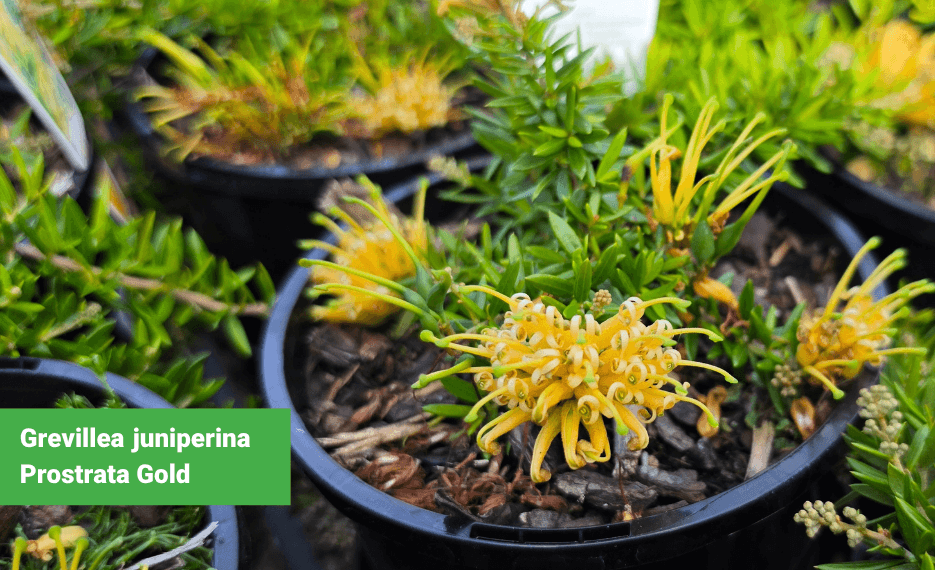
Grevillea juniperina Prostrata Gold
Prostrate Golden Juniper Leaf Grevillea
Grevillea Prostrata Gold is particularly low and wide, reaching only around 20cm high while spreading approximately 3m.
Fine needle-like foliage carries masses of golden spider flowers, particularly through winter and spring. Its prostrate habit makes it a useful plant for rockeries and for spilling over retaining walls.
The flowers also attract native birds and bees.
-Copy-1.png)
Grevillea juniperina Prostrata Yellow
Prostrate Juniper Leaf Grevillea
Grevillea Prostrata Yellow forms a broad, low carpet of fine foliage, making it a useful choice where you want coverage without height.
Bright yellow spider flowers add seasonal colour through winter and spring, while the wide-spreading habit works well across rockeries, along retaining walls and through larger native plantings. It typically stays around 20cm high while spreading up to approximately 3m.

Grevillea juniperina Gold Cluster
Juniper Leaf Grevillea
Grevillea Gold Cluster is a more compact option, generally reaching around 30cm high and 80cm–1m wide.
Masses of golden flowers contrast against green foliage through winter and spring. Its dense growth makes it useful where tighter ground coverage is wanted, including areas where helping to reduce weed competition is part of the planting objective.
Bronze and burgundy foliage Grevilleas
With these Grevilleas, the flowers are only part of the colour story.
Bronze, red and burgundy tones through new growth can add valuable foliage contrast, giving the plants interest even when they are not at peak flower.
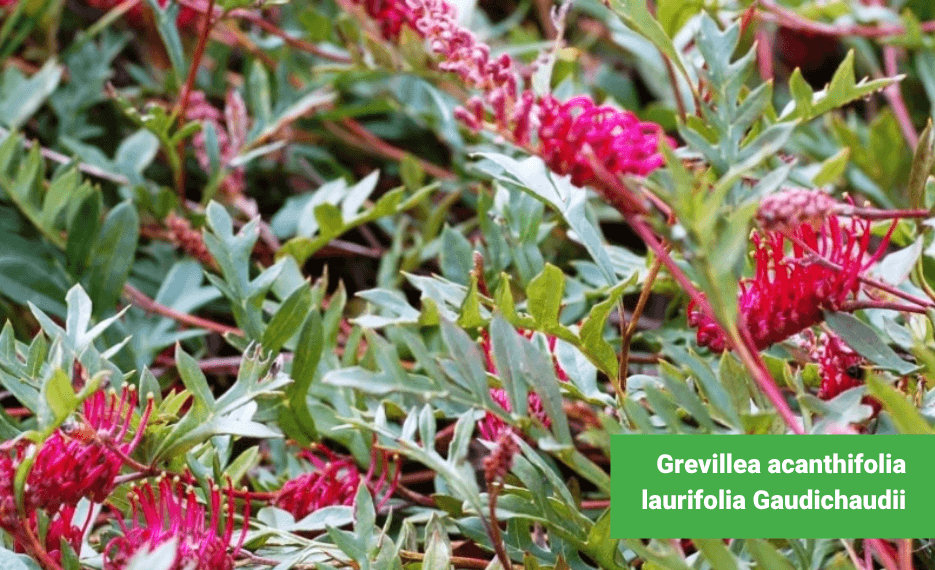
Grevillea acanthifolia laurifolia Gaudichaudii
Spider Flower or Toothbrush Plant
Grevillea Gaudichaudii is a vigorous, low-spreading native with strongly textured foliage and red toothbrush-style flowers.
New growth can bring attractive bronze to burgundy tones, adding another layer of colour beyond the flowers.
It can spread up to 5m wide, making it particularly useful for covering larger areas, sprawling through garden beds or spilling over retaining walls.
It is also useful in coastal planting and attracts nectar-feeding birds.
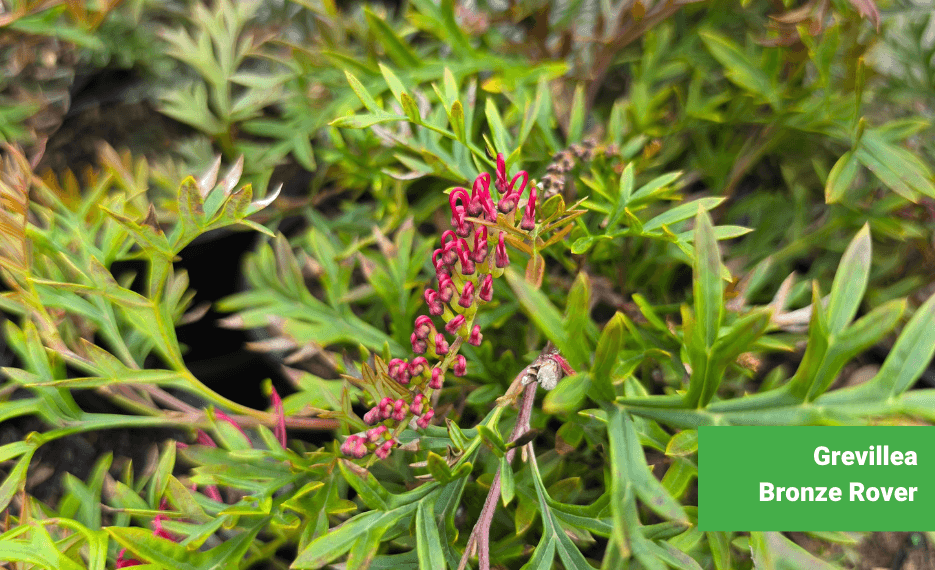
Grevillea hybrida Bronze Rover
Spider Flower or Toothbrush Plant
The name gives away one of the standout features of Grevillea Bronze Rover.
Its fine, toothed foliage produces bronze-tinged new growth, complemented by red brush-like flowers. A dense, prostrate habit allows it to spread to around 2m.
Bronze Rover is particularly useful on embankments, slopes and other difficult sites where low-growing coverage is required.
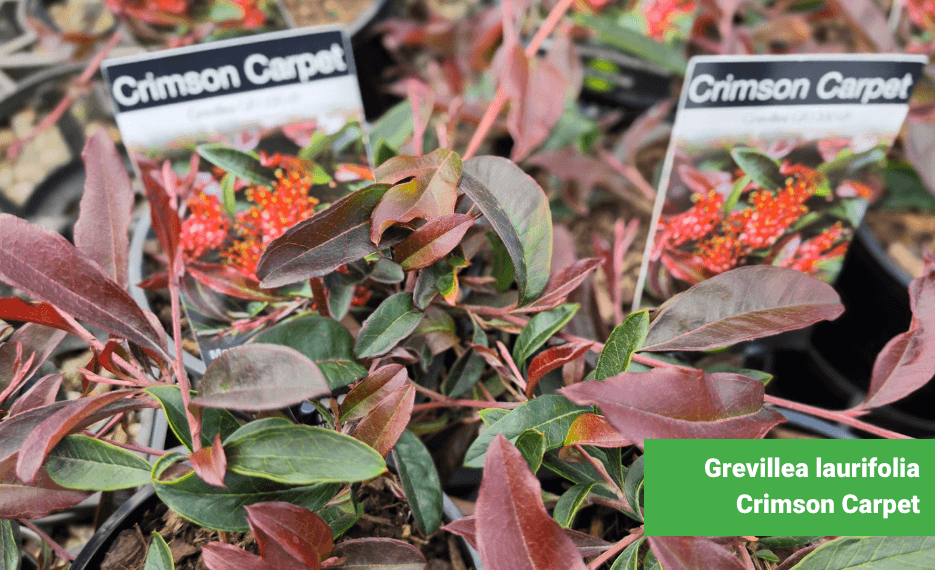
Grevillea laurifolia Crimson Carpet
Laurel Leaf Grevillea
Grevillea Crimson Carpet combines crimson-red toothbrush flowers with bronze-tinged new foliage.
It forms a dense carpet only around 20cm high, making it useful on slopes, embankments and other locations where a very low spreading plant is required.
Its dense growth can also be useful for difficult sites and erosion-control planting.
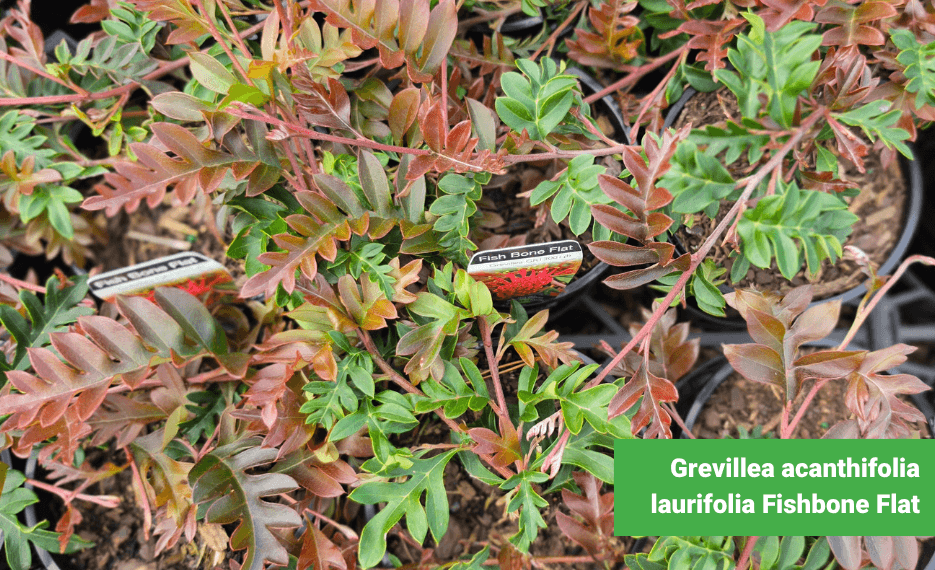
Grevillea acanthifolia laurifolia Fishbone Flat
Spider Flower or Toothbrush Plant
Grevillea Fishbone Flat brings another foliage texture into the mix.
Deeply divided green foliage is highlighted by burgundy-toned new growth, while red brush-like flowers provide additional seasonal colour.
Its spreading, prostrate habit makes it suited to rockeries, slopes, embankments and larger areas where broad native ground coverage is needed.
Where to use Groundcover Grevilleas
Slopes and embankments
Groundcover Grevilleas are particularly useful on slopes where taller shrubs may create too much bulk.
Low, spreading varieties such as Grevillea Bronze Rover, Crimson Carpet, Fishbone Flat and Gin Gin Gem can follow the contours of the land while gradually covering more of the exposed soil.
Retaining walls
Prostrate varieties can soften retaining walls and other hard landscape edges as their growth spreads towards or over the edge.
Grevillea juniperina Prostrata Gold, Prostrata Yellow and Gaudichaudii are particularly useful for this type of planting.
Under and between larger natives
Groundcover Grevilleas can create another planting layer beneath taller native shrubs and open-canopied trees, provided the chosen variety receives enough light for healthy growth and flowering.
This layered approach can help a landscape feel fuller while reducing large areas of exposed soil.
Mass planting
Repeating one cultivar can create a consistent ground layer across larger landscape projects.
Alternatively, different Grevillea groundcover varieties can be combined to introduce changes in flower colour, foliage and texture while keeping the planting predominantly low.
Habitat-friendly landscapes
Grevilleas are well known for producing nectar-rich flowers that attract birds and insects.
Including flowering Groundcover Grevilleas means habitat value can extend right down through the planting rather than being limited to taller shrubs and trees.
How to grow Groundcover Grevilleas
The exact requirements vary between varieties, but the Grevilleas featured here share several broad preferences.
Sun
Most Groundcover Grevilleas perform best in full sun, where they generally produce their strongest growth and flowering.
Some cultivars also tolerate part shade or semi-shade, including Grevillea Gin Gin Gem, Simply Stunning, Prostrata Gold, Gold Cluster, Bronze Rover and Fishbone Flat.
Always match the individual cultivar to the conditions of the site.
Soil and drainage
Good drainage is particularly important for Grevilleas.
Many tolerate a range of soil types, but persistently wet or waterlogged soil can cause problems. Improving drainage before planting can therefore be just as important as choosing the right variety.
Watering
Newly planted Grevilleas should be watered regularly while their root systems establish.
Once established, many groundcover Grevilleas tolerate periods of dry weather well, which can make them useful in lower-water and low-maintenance landscapes.
Drought tolerance still varies by cultivar, soil and climate, and plants may need additional water during extended periods of heat or drought.
Spacing
One of the most important things to check before planting is mature spread.
Groundcover Grevilleas may look relatively small in a nursery pot, but some eventually spread two, three or even several metres.
Spacing according to mature width gives the plants enough room to develop their natural habit while allowing the planting to gradually cover the required area.
Pruning
Many groundcover Grevilleas need little pruning.
Light trimming can be used to maintain shape, improve density or control growth extending beyond the intended planting area.
Avoid cutting heavily into old, bare wood unless the particular variety is known to respond well.
What fertiliser should you use on Grevilleas?
Grevilleas belong to the Proteaceae family, a group that includes plants adapted to soils naturally low in phosphorus.
For this reason, high-phosphorus fertilisers can damage phosphorus-sensitive Grevilleas. A fertiliser specifically formulated for Australian native plants and low in phosphorus is the safer choice when feeding is required.
Spring is a useful time to assess established plants as active new growth begins.
Always follow the application rate on the fertiliser being used rather than assuming more fertiliser will produce better growth.
Plantmark stocks a range of native plant foods, low-phosphorus fertilisers and potting mixes suitable for Australian native plants.
FAQ's about Groundcover Grevilleas
1. Are Grevilleas good groundcovers?
Yes. A number of Grevillea species and cultivars have naturally low, prostrate or spreading habits.
Depending on the variety, they can be used to cover slopes, embankments, retaining walls, rockeries, borders and larger areas between taller plants.
2. Do groundcover Grevilleas help suppress weeds?
Yes. Dense groundcover Grevilleas can help reduce weed pressure by occupying open space and covering more of the soil surface as they establish.
They will not eliminate weeds completely, particularly while plants are young, but they can form part of an effective approach to reducing areas of exposed soil.
3. Are groundcover Grevilleas drought tolerant?
Many are drought tolerant once established.
New plants need regular watering while their root systems develop, and drought tolerance varies between cultivars, climates and soil conditions.
4. Do Grevilleas need full sun?
Most flower and grow best in full sun, although a number of groundcover varieties also tolerate part shade.
Check the requirements of the individual cultivar before selecting plants for a project.
5. What soil is best for Grevilleas?
Good drainage is one of the most important requirements.
Many Grevilleas tolerate several soil types, but they generally perform poorly in persistently wet or waterlogged soil.
6. What fertiliser should I use for Grevilleas?
Choose a fertiliser formulated for Australian native plants with low phosphorus.
Many Grevilleas are sensitive to excessive phosphorus, so standard high-phosphorus garden fertilisers may not be suitable.
7. Do groundcover Grevilleas attract birds and pollinators?
Many do. Grevilleas produce nectar-rich flowers that can attract nectar-feeding birds and insects.
The amount of wildlife activity will vary according to the cultivar, flowering period and surrounding habitat.
Find Groundcover Grevilleas at Plantmark
Looking for groundcover Grevilleas for an upcoming landscape project?
Plantmark stocks a broad range of low-growing and spreading Grevilleas across our Wholesale Nurseries in Melbourne, Brisbane and the Gold Coast.
Head to our Plant Search section on our website to view current availability and pot sizes at your preferred Plantmark location, then make sure you visit us soon to see the range for yourself.
For larger projects, bulk quantities or plants that are not currently available at your preferred location, speak with your closest Quotes & Orders team. We can assist with sourcing and arrange delivery directly to your landscape project.
Plantmark is a wholesale nursery. Trade only.
Leave your comment