
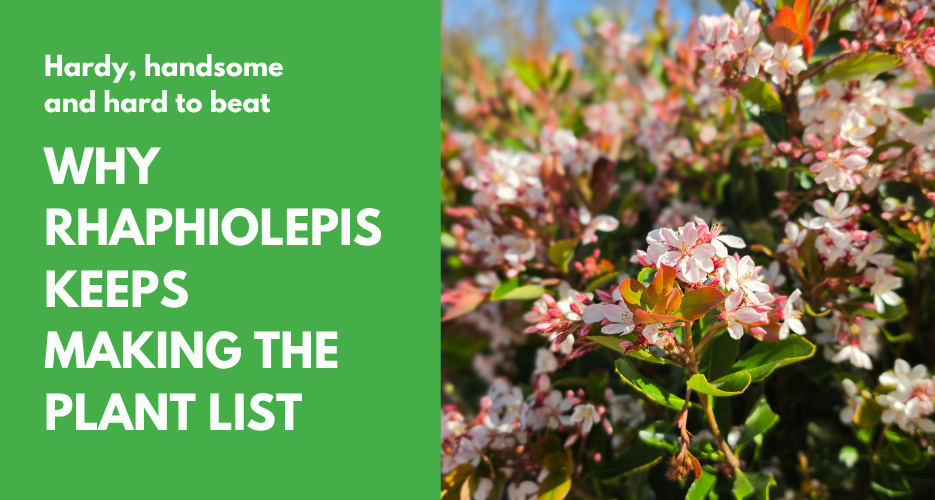
Rhaphiolepis, commonly known as Indian Hawthorn, is one of those reliable landscape shrubs that combines good looks with very little fuss.
Evergreen, hardy and naturally rounded, it can be used for low hedges, clipped spheres, mass planting, garden beds and pots. Once established, it has relatively low water needs and handles wind, coastal conditions and salt spray, while spring and early summer bring clusters of white or pink flowers.
There are compact forms for smaller spaces and containers, as well as larger varieties for broader garden beds and low screening.
It’s easy to see why landscapers keep coming back to it.
Why is Rhaphiolepis so popular with landscapers?
Good looks with very little fuss is probably the simplest answer.
Rhaphiolepis is evergreen, naturally dense and generally easy to maintain. Once established, it is drought tolerant and many varieties cope well with wind, salt spray and coastal conditions.
Then there’s its form.
Rather than needing constant work to create structure, Rhaphiolepis naturally develops into a neat, rounded shrub. Leave it a little looser for an informal garden or regularly clip it for a more structured finish.
And in spring and early summer, the foliage is joined by clusters of white or pink flowers.
For a relatively straightforward shrub, it can do a surprising amount of work in a landscape.
The sphere look, made easy
Clipped spheres are a popular way to introduce structure and repetition into contemporary and formal landscapes, and Rhaphiolepis is particularly well suited to the look.
Its naturally dense, rounded growth means you’re already starting with the right shape.
Varieties including Rhaphiolepis indica Oriental Pearl, Rhaphiolepis indica Snow Maiden and Rhaphiolepis rosiflora Hot Tips are especially useful for clipped spheres and compact topiary.
Even better for busy landscape projects, Plantmark also stocks selected Rhaphiolepis varieties, including Oriental Pearl, already clipped into spheres. That gives you an established shape from day one while saving time and labour on site.
Use a single sphere as a structural feature or repeat them through a planting for rhythm and consistency.
They also work beautifully beneath feature trees. Rounded Rhaphiolepis planted below Lagerstroemia, for example, creates a classic layered look while still allowing the tree trunks and canopy to remain visually distinct.
Where can Rhaphiolepis be used in a landscape?
One of the strengths of Indian Hawthorn is how easily it moves between different landscape applications.
Low hedges
Its dense evergreen growth makes Rhaphiolepis an easy choice for low formal or informal hedges.
For a more formal finish, clip regularly to maintain a defined line. For a softer look, allow the plants to keep more of their naturally rounded shape.
Mass planting
Rhaphiolepis becomes particularly effective when repeated across a larger area.
Mass planting reinforces its rounded growth habit and creates a consistent evergreen layer, with the flower display becoming even stronger when multiple plants bloom together.
Garden beds and layered planting
Use Rhaphiolepis towards the front or middle of a garden bed, depending on the cultivar.
Its compact foliage provides useful structure beneath feature trees and taller shrubs while allowing seasonal flowering plants and foliage contrasts to be layered around it.
Pots and planters
Compact varieties can also perform well in pots and planters.
Rhaphiolepis indica Snow Maiden, Rhaphiolepis indica fergusonii Little Bliss and Rhaphiolepis indica Oriental Pearl are particularly useful where you want a neat evergreen shrub without committing to a larger-growing variety.
Coastal landscapes
Rhaphiolepis has long been valued in coastal planting because of its tolerance of wind and salt spray.
Rhaphiolepis indica Oriental Pearl is particularly useful around coastal gardens and saltwater pools, while Indian Hawthorn more broadly works well in exposed coastal landscapes.
And then there are the flowers
For such a tough shrub, Rhaphiolepis can put on a surprisingly soft flower display.
Clusters of white or pink blooms appear across the foliage, usually through spring and early summer depending on the cultivar. Some selections flower over an even longer period.
And when the flowers arrive, so do the bees. 🐝
That gives Rhaphiolepis another layer of landscape value: evergreen structure for most of the year, then seasonal flowers bringing colour and activity into the planting.
The only question is whether you go classic white or bring in the pink.
White-flowering Rhaphiolepis varieties
White flowers against glossy dark foliage give these varieties a clean, classic look that works particularly well through formal, contemporary and layered garden planting.
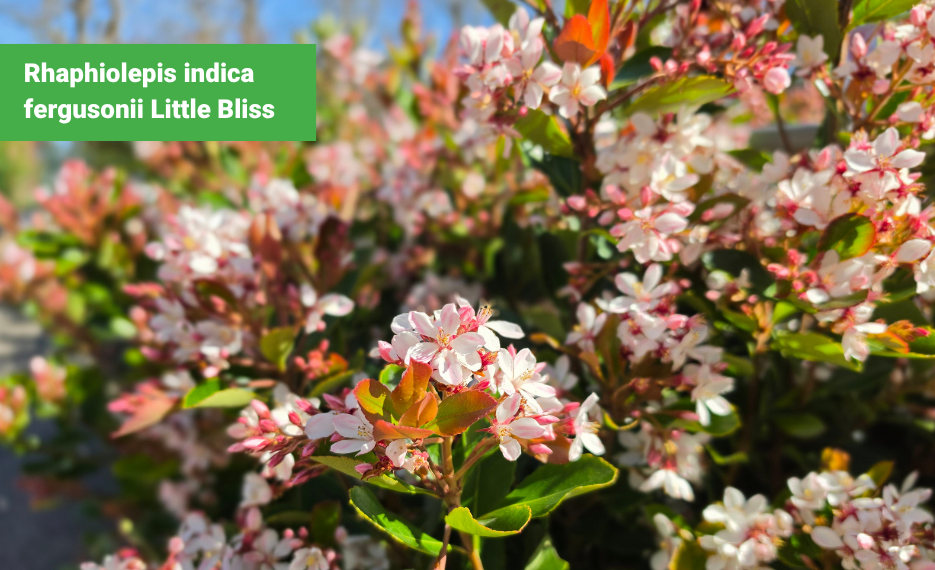
Rhaphiolepis indica fergusonii Little Bliss
Indian Hawthorn
Compact growth, glossy foliage and colourful new tips.
Rhaphiolepis Little Bliss stays compact at approximately 60cm–1m high and wide, making it particularly useful for lower planting, compact hedges and pots.
Dark leathery green leaves are highlighted by red-tipped fresh growth, while dainty white to pale pink flowers appear through spring and summer.
Its naturally dense, rounded form also lends itself well to clipping and structured planting.
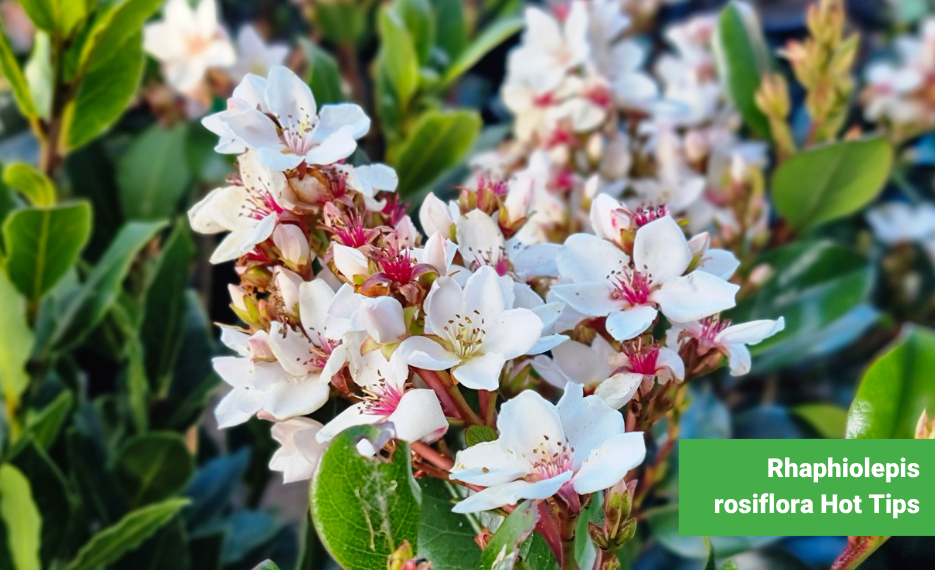
Rhaphiolepis rosiflora Hot Tips
Indian Hawthorn
White flowers with foliage colour that changes with the seasons.
Rhaphiolepis Hot Tips earns its place for more than the spring flower display.
Glossy dark green foliage develops vibrant orange tips as the weather cools, before deepening towards red through winter. Masses of white flowers then appear in spring.
Growing to approximately 1m high x 1m wide, its dense rounded growth works well for low hedges, garden beds and clipped forms.
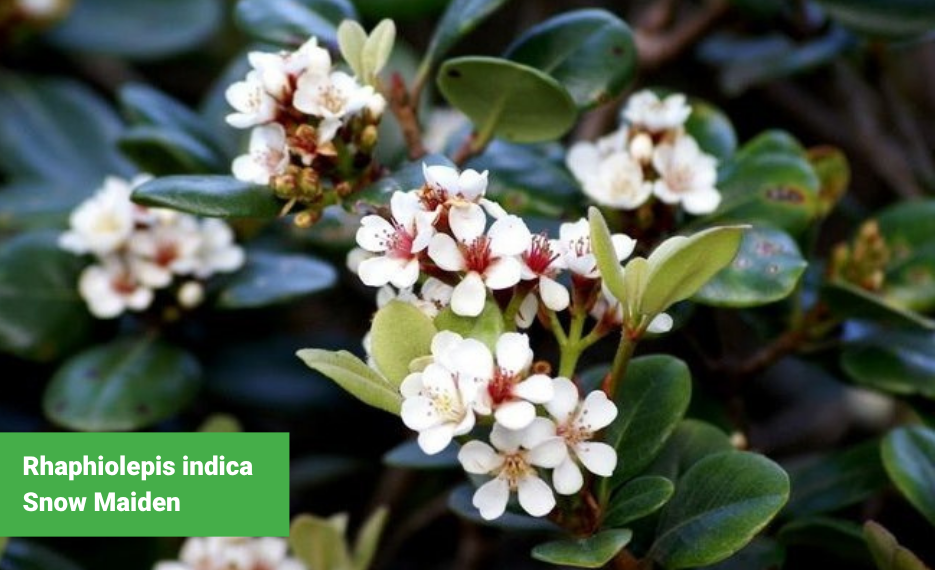
Rhaphiolepis indica Snow Maiden
Indian Hawthorn
Compact, fragrant and particularly good for smaller spaces.
Rhaphiolepis Snow Maiden produces clusters of fragrant white flowers against glossy dark green foliage.
At approximately 90cm high x 50cm wide, it is one of the narrower compact options in the group, making it useful for low hedges, borders and container planting.
Its naturally rounded form also looks particularly effective when mass planted.
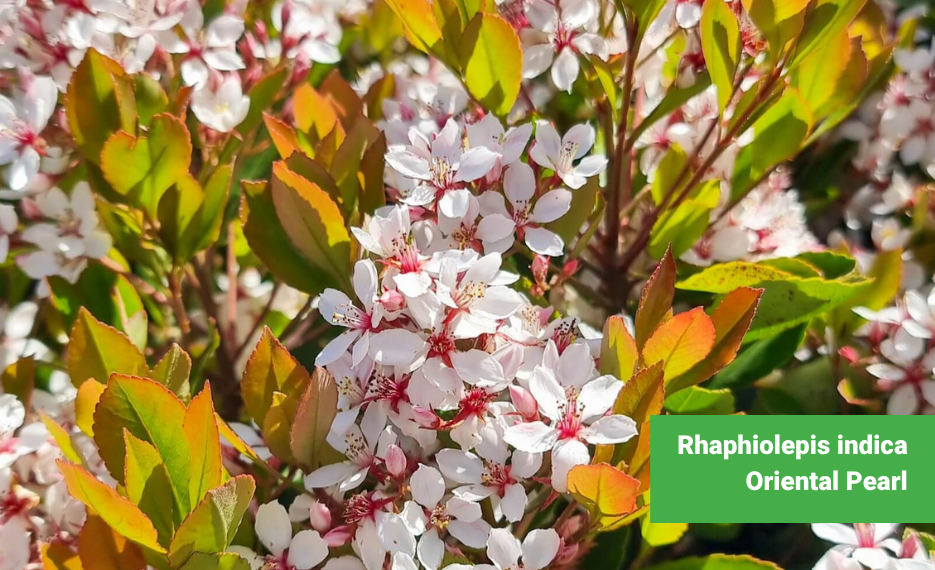
Rhaphiolepis indica Oriental Pearl
Indian Hawthorn
One of our favourites for spheres, low hedging and coastal landscapes.
Rhaphiolepis Oriental Pearl combines glossy dark green foliage with masses of white flowers that can continue over an extended flowering period.
Its dense rounded habit reaches approximately 1m high x 1m wide and is particularly easy to work into clipped spheres, low hedges and planters.
It also handles heat, frost and salt spray well, making it a strong option for coastal landscapes and planting around saltwater pools.
Look out for Oriental Pearl already clipped into spheres at Plantmark too — a handy option when you want that established topiary look without the time and labour involved in shaping plants from scratch.
Pink-flowering Rhaphiolepis varieties
Prefer a little more colour?
Pink Rhaphiolepis varieties offer the same hardy evergreen structure, but their flowers bring warmer colour into the landscape.
From soft pink sprays to stronger rosy blooms, these are some of the varieties catching our eye.
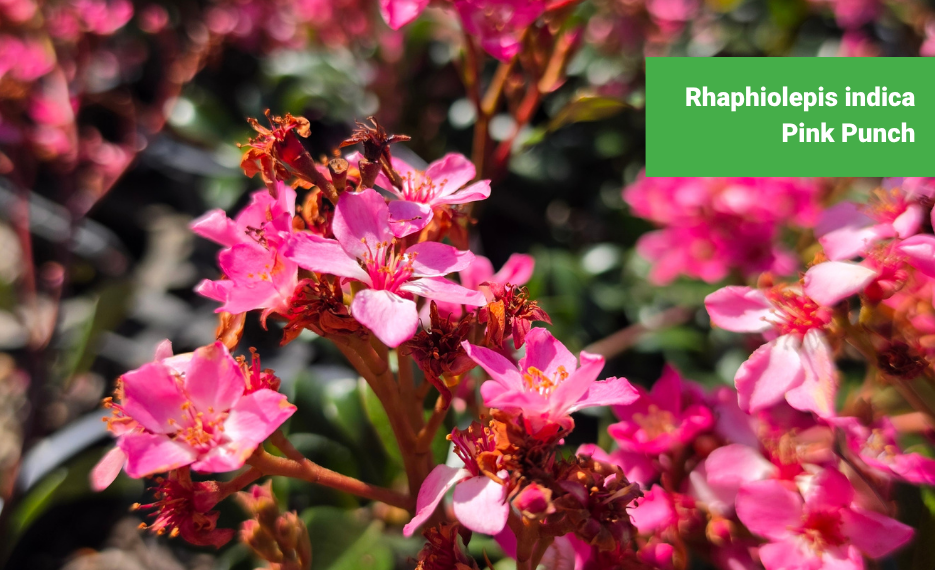
Rhaphiolepis indica Pink Punch
Indian Hawthorn
Intense pink flowers on a dense, rounded evergreen shrub.
Rhaphiolepis Pink Punch earns its name from the particularly intense pink colour of its flowers, creating a much stronger hit of colour than the softer pink-flowering forms.
It is also a larger option than many of the compact cultivars, generally growing approximately 1–2m high x 1–2m wide.
Its evergreen foliage, rounded form and vivid flowers make it useful where you want more substantial structure through garden beds, borders or low screening without losing the classic Rhaphiolepis shape.
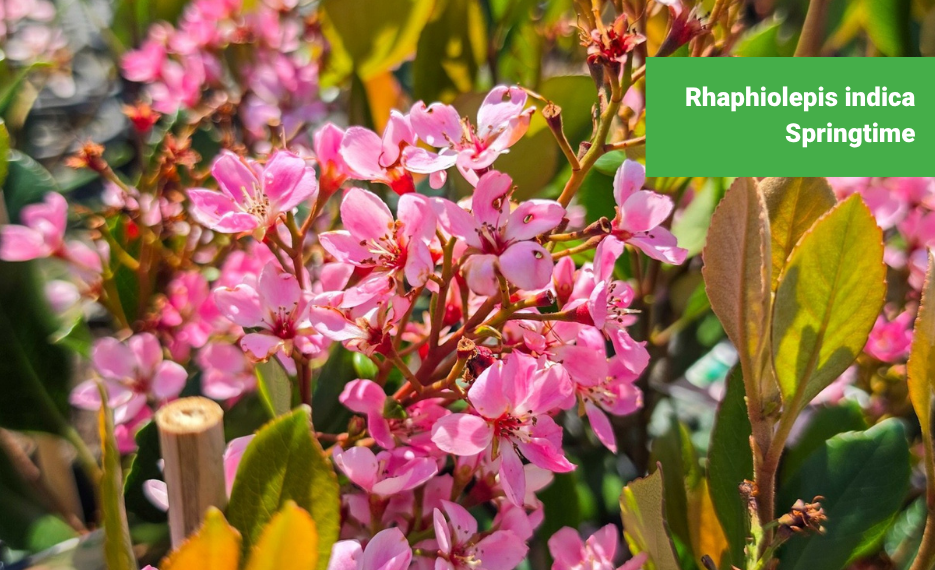
Rhaphiolepis indica Springtime
Indian Hawthorn
Fragrant star-shaped pink flowers against glossy green foliage.
Rhaphiolepis Springtime produces beautiful fragrant pink flowers in spring, set against dark leathery evergreen leaves.
It is a broader-growing option than some of the dwarf cultivars and works particularly well where you want a more substantial informal hedge, mass planting or flowering shrub layer.
Like most Rhaphiolepis, it will tolerate semi-shade but flowers more heavily in full sun.
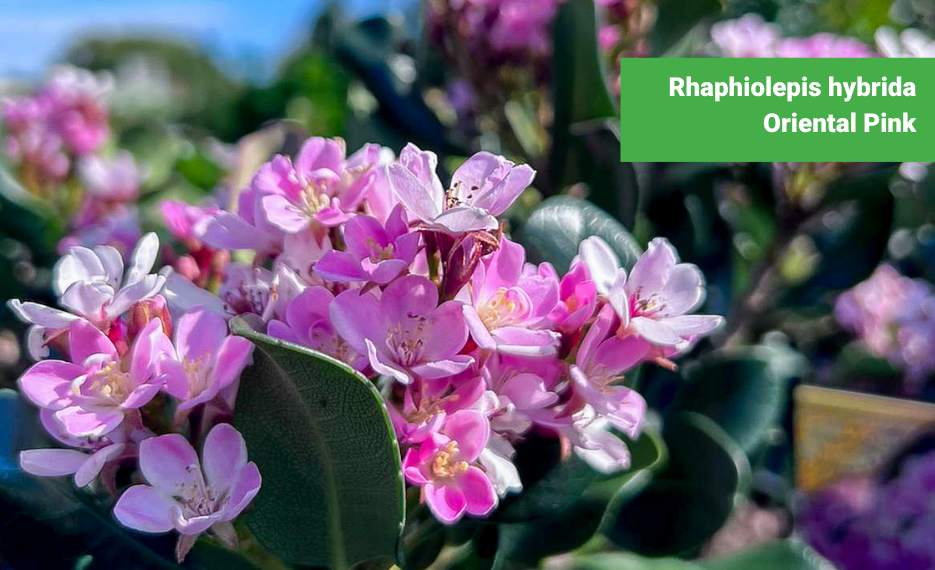
Rhaphiolepis hybrida Oriental Pink
Indian Hawthorn
Soft pink flowers and a naturally neat, rounded habit.
Rhaphiolepis Oriental Pink is a bushy, low-growing evergreen shrub celebrated for its strong growth, clean glossy foliage and abundant soft pink flowers.
Dense flower sprays appear through spring, while its naturally rounded form gives it useful structure outside flowering season.
It grows approximately 1–2m high x 60cm–1m wide and can also be grown as a standard for a different landscape effect.
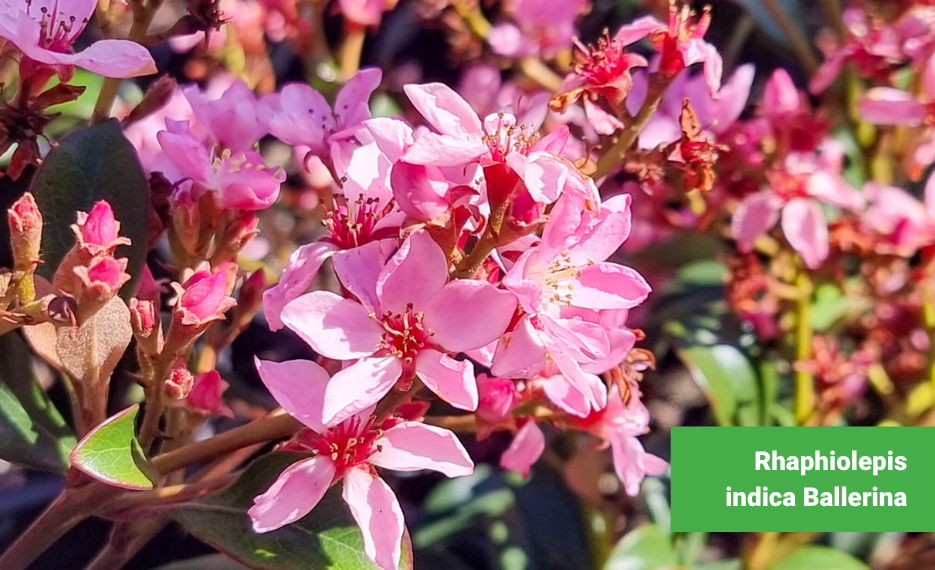
Rhaphiolepis indica Ballerina
Indian Hawthorn
A compact pink-flowering favourite for low, structured planting.
Rhaphiolepis Ballerina combines a dense rounded habit with glossy dark green foliage and pink flowers through winter and spring.
At approximately 60cm–1m high and wide, it is useful for lower hedging, garden beds and smaller spaces where you want the classic Indian Hawthorn look without the size of a larger cultivar.
More Rhaphiolepis to explore at Plantmark
These eight are only a snapshot of the Rhaphiolepis range available through Plantmark.
Depending on current stock, you may also find varieties such as Rhaphiolepis indica Maximus, a larger compact and rounded form useful for low to medium hedging; Rhaphiolepis indica Minikins, a particularly low-growing variety reaching around 50cm; and Rhaphiolepis umbellata, commonly known as Yedda Hawthorn.
And there are plenty more.
Head to the Plantmark Plant Finder to search Rhaphiolepis and see current varieties, pot sizes and availability at your preferred wholesale nursery.
Which Rhaphiolepis is best for pots?
Compact varieties are the easiest Rhaphiolepis to manage in containers.
Rhaphiolepis Snow Maiden is an especially good choice because of its narrow, compact growth, while Rhaphiolepis Little Bliss and Oriental Pearl also lend themselves well to pots and planters.
For an even smaller option, Rhaphiolepis indica Minikins grows to approximately 50cm high x 50cm wide.
Use a generously sized container with good drainage and remember that plants growing in pots generally require more regular watering than established Rhaphiolepis planted in the ground.
Which Rhaphiolepis is best for spheres?
Rhaphiolepis Oriental Pearl, Snow Maiden and Hot Tips are particularly good choices for clipped spheres because of their naturally dense, rounded growth.
Rhaphiolepis Little Bliss is another compact option where a smaller finished size is preferred.
Plantmark also stocks selected Rhaphiolepis already clipped into spheres, including Oriental Pearl, making it easier to achieve an established, structured look while reducing labour on site.
How to grow Rhaphiolepis
Part of the appeal of Indian Hawthorn is just how adaptable it is.
Sun
Rhaphiolepis grows in full sun to semi-shade.
For the strongest flowering, choose a position with plenty of sun. Most varieties will still grow happily with some shade, but sunnier positions generally produce the best flower display.
Soil and drainage
Another reason landscapers keep coming back to Rhaphiolepis is its adaptability.
It will grow happily in a wide range of soil types, including sandy, loamy and heavier soils, provided the site has reasonable drainage.
That flexibility makes it useful across a broad range of landscape projects where soil conditions may not be perfect or completely consistent across the site.
Avoid prolonged waterlogging, particularly while plants are establishing.
Watering
Water regularly while new plants establish their root systems.
Once established, Rhaphiolepis generally has relatively low water requirements and good drought tolerance.
That is becoming an increasingly useful landscape trait. As hotter, drier conditions and changing climate patterns put more focus on water-efficient landscapes, plants that can maintain good structure and appearance without relying on heavy irrigation have a clear advantage.
Rhaphiolepis still benefits from additional watering through prolonged periods of extreme heat and drought, particularly on very exposed sites.
Coastal conditions
Rhaphiolepis handles coastal exposure particularly well.
Many varieties tolerate wind and salt spray, making Indian Hawthorn a useful choice for coastal landscapes, exposed sites and planting around saltwater pools.
Pruning
Rhaphiolepis responds well to clipping, which is one reason it works so well for hedges and spheres.
Light, regular pruning helps maintain density and shape. If flowers are important, pruning after the main flowering period helps avoid removing developing flower buds.
Frequently asked questions about Rhaphiolepis
1. Is Rhaphiolepis drought tolerant?
Yes. Rhaphiolepis is generally drought tolerant once established.
New plants should still be watered regularly while roots establish, and additional water may be required during extended periods of extreme heat or drought.
2. Can Rhaphiolepis grow in semi-shade?
Yes.
Most Indian Hawthorn varieties grow in full sun to semi-shade, although flowering is generally strongest in sunnier positions.
3. Can Rhaphiolepis grow in pots?
Yes. Compact varieties are particularly well suited to pots and planters.
Rhaphiolepis indica Snow Maiden, Little Bliss, Oriental Pearl and Rhaphiolepis indica Minikins are useful options where a smaller, naturally rounded evergreen shrub is wanted.
4. Is Rhaphiolepis suitable for coastal gardens?
Yes. Rhaphiolepis is well known for tolerating wind, coastal conditions and salt spray.
Rhaphiolepis indica Oriental Pearl and Minikins are particularly useful coastal options and can be used around saltwater pools.
5. Can Rhaphiolepis be clipped into spheres?
Yes. Its naturally dense, rounded growth makes Rhaphiolepis particularly easy to shape into spheres.
Rhaphiolepis Oriental Pearl, Snow Maiden and Hot Tips are among our favourite varieties for this use.
You can also find selected Rhaphiolepis at Plantmark already shaped into topiary spheres, saving time and labour on landscape projects.
6. When does Rhaphiolepis flower?
Most varieties flower strongly through winter, spring or early summer, with flowering periods varying between cultivars.
Some selections continue flowering for longer, so choosing several varieties can help extend colour across the season.
7. Do bees like Rhaphiolepis flowers?
Yes. Bees are commonly seen visiting the clusters of Rhaphiolepis flowers when plants are in bloom.
Using flowering shrubs alongside other plants that bloom at different times can help provide a longer season of floral resources through the landscape.
8. Is Rhaphiolepis native to Australia?
No. Rhaphiolepis is native to parts of eastern and south-eastern Asia and is widely grown as an ornamental landscape shrub in Australia.
9. How big does Rhaphiolepis grow?
It depends on the cultivar.
Compact varieties such as Rhaphiolepis Minikins, Snow Maiden, Little Bliss and Rhaphiolepis Ballerina generally stay around or below 1m.
Larger forms such as Rhaphiolepis Pink Punch, Springtime and Rhaphiolepis indica Maximus can create more substantial shrubs and hedges.
Always check the mature dimensions of the individual variety before spacing plants for a hedge, mass planting or container.
Find Rhaphiolepis at Plantmark
Looking for Rhaphiolepis for an upcoming landscape project?
Plantmark stocks a broad range of Indian Hawthorn across our wholesale nurseries in Melbourne, Brisbane and the Gold Coast, from compact white-flowering varieties and vivid pink forms to larger hedging plants and pre-clipped topiary spheres.
Head to the Plantmark Plant Finder to check current varieties, availability and pot sizes at your preferred Plantmark location, then visit us soon to see the range for yourself.
For larger landscape projects, bulk quantities or plants that aren’t currently available at your preferred location, request a quote or speak with your closest Plantmark Quotes & Orders team. We can assist with sourcing and arrange delivery directly to your landscape project.
Plantmark is a wholesale nursery. Trade only.
Related reading
Topiary sphere alternatives – 10 great options for Australian landscapes
Leave your comment